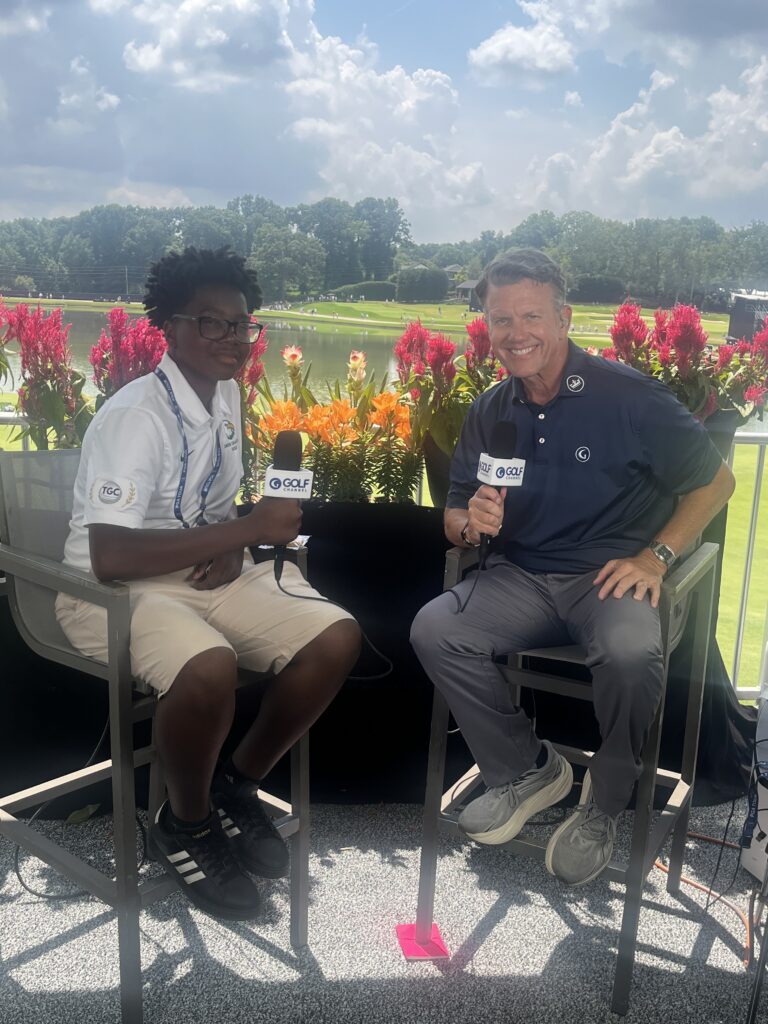
 On the second day of the 2026 TOUR Championship, I had the privilege of being Drew Charter School’s TOUR Championship media correspondent. I got to experience many parts of the TOUR Championship, including the behind-the-scenes media aspects and the open-access spectator experiences. One of my favorite activities was “street interviews,” where Braeden Prell, a content specialist at See.Spark.Go, and I asked random TOUR spectators questions about golf and their experiences at the TOUR. I also had the opportunity to talk to Todd Lewis with the Golf Channel. I had a great time, but I also learned a lot about what goes into putting on and maintaining the TOUR Championship.
Throughout my time at the TOUR, I shadowed many different interviews, which were very informative. The first interview was between the award-winning Alex Forbes from FOX 5 and the TOUR Championship meteorologist, Wade Stettner. The TOUR has a dedicated meteorologist who works with a team to keep the TOUR and TOUR-goers informed about and safe from any possible weather conditions. Another was an interview with Ilham Askia, President and CEO of the East Lake Foundation. She discussed the social aspects that both go into and come out of the TOUR and how there’s a newfound opportunity for these benefits to spread to other communities in the US. Finally, I got to watch Patrick Snell, a sports reporter with CNN World Sport, report live on TOUR golf. The way he spoke, the way his producer organized everything, and the way that the camera operator set up the framing and lighting all contributed to the perfect shot. All of these are aspects that go into putting on the TOUR Championship that not many people know about.

In addition, I also got to experience many spectator attractions. One of these was the Zyrtec booth, where you could get a custom golf towel with your initials embroidered on it. It used an automatic sewing machine to embroider quickly, efficiently, and consistently. They also had a putt-putt course, with a giant nose that sneezed when you hit a ball through it. None of what made that experience special could have been done without engineering.
The other technical aspect is the broadcasting side. There is a team of people who coordinate the players and media before and after the players’ rounds. They watch the rounds in real time and direct them to different news channels as they complete their rounds. Once the players are in interviews, the camera and sound work begins. There are many teams with different organizations who record interviews and communicate with producers to get a great finished product.
All in all, the TOUR Championship cannot run without all of these different parts running smoothly, and the people who do all of this should be recognized for their hard work. The next time you attend or watch a golf tournament, remember that there’s more to golf than meets the eye.
By Christian Sayers, Drew Charter School Junior and Varsity Golfer